
Denture Repair Impression Guide
This guide can help your team quickly determine what impressions or models to send with common denture repairs and modifications.
Facing a more complex case? Our technicians are always available to advise on recommended workflows, impressions to send, turnaround times, and more.
Typical Impressions for Denture Repairs

Standard Impression
Taken without the prosthesis in the mouth. Used when the lab needs a record of the patient’s anatomy without the partial or denture.

Pick-Up Impression
Taken with the prosthesis fully seated in the patient’s mouth. This captures how the prosthesis fits against the soft tissue, including the natural tissue displacement.

Opposing Arch
Records the opposing dentition or arch. Used to check the bite and occlusion, such as when the lab adds a new tooth or modifies a clasp.

Bite Registration
Records the patient’s occlusal relationship. Used with an opposing impression to articulate dental models with the greatest accuracy.

Wash/Reline Impression
Impression material is placed inside the existing prosthesis to capture the soft tissues.

Denture Repair Impression Guide
This guide can help your team quickly determine what impressions or models to send with common denture repairs and modifications. Facing a more complex case? Our technicians are always available to advise on recommended workflows, impressions to send, turnaround times, and more.
Sending Scans?
Please contact us to discuss the case, requested repair or modification, and desired turnaround. Our technicians can use intraoral scans or digital models for many common repairs, but in some circumstances, an analog pick-up impression with alginate or PVS may be necessary. Whenever possible, we will accommodate your preferences and the needs of your patient.
Damaged or Debonded/Lost Tooth

Replacing an existing tooth, not a new extraction (i.e., no changes to occlusion)
SEND DENTURE ONLY
USEFUL TO CONFIRM TOOTH PLACEMENT AND OCCLUSION
Add New Tooth After Extraction

New denture tooth added to appliance to restore terminal dentition
OPTIONAL IF MODELS CAN BE HAND ARTICULATED EASILY

Broken Clasp (or Add New Clasp)

Broken or damaged metal clasp, wrought wire clasp, or flexible clasp
RECOMMENDED IF CLASP PLACEMENT MAY INTERFERE WITH OCCLUSION
Complex Repair (Multiple Modifications or Elements)

Appliance has significant damage, needs complex modifications, or fits challenging anatomy
OPTIONAL IF MODELS CAN BE HAND ARTICULATED EASILY

Visible gap between appliance and patient's tissue, indicating tissue resorption
OPTIONAL IF MODELS CAN BE HAND ARTICULATED EASILY
Reline or Rebase

Adapt existing partial or denture to fit patient's current tissue for a true, comfortable fit
Cracked or Fractured Denture Base
Such as a hairline crack in the denture base, or if broken, the pieces fit together perfectly
SEND DENTURE ONLY
TYPICALLY NO IMPRESSIONS NEEDED
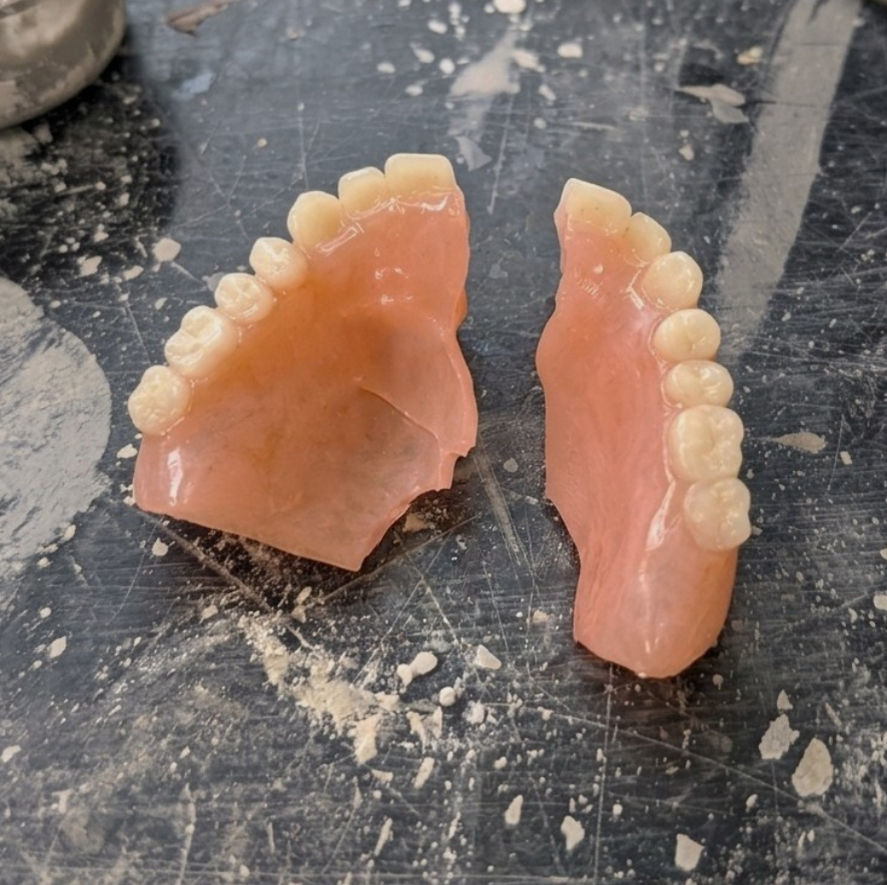
MISSING PIECES

SIMPLE CRACK